
Capabilities
The laboratory, the packs and the site
What releases the material, what it leaves in, what keeps a flammable-liquid site licensed, and where it all sits — described in the terms an engineer or a quality auditor would use. Specific parameters, capacities and turnaround times are confirmed against your requirement rather than published.
Laboratory
The laboratory is the product
Everything upstream of the laboratory is a claim. The certificate of analysis is the only part a customer can actually verify, which is why the laboratory is where the money goes.
What is tested
Alcohol content and density, water content, volatile impurities, oxidisable congeners, ultraviolet behaviour, non-volatile residue and acidity — the panel appropriate to the grade, against the standard the order cites.
Every line has a method
No parameter appears on an ATHIR specification unless the laboratory can produce it against a named method with a validation record behind it.
Data integrity
Instrument audit trails, controlled worksheets and second-person review on every release. This is not optional in a laboratory that releases pharmaceutical material.
Sensory assessment
For perfumery material, a trained panel evaporates the alcohol from a smelling strip and confirms it leaves nothing behind through the dry-down. No instrument performs that test.
Retention samples
A retained sample of every batch, held under controlled conditions for the full retest period.
Change control
Written notification before any change to process, site, source or specification, with agreed lead time. Pharmaceutical buyers weight this above any certificate.
Packing & transport
Four packs, drawn to scale
Ethanol is a Class 3 flammable liquid, UN 1170, packing group II. Every pack we fill is approved for that classification, and every movement travels with the declaration the mode requires.
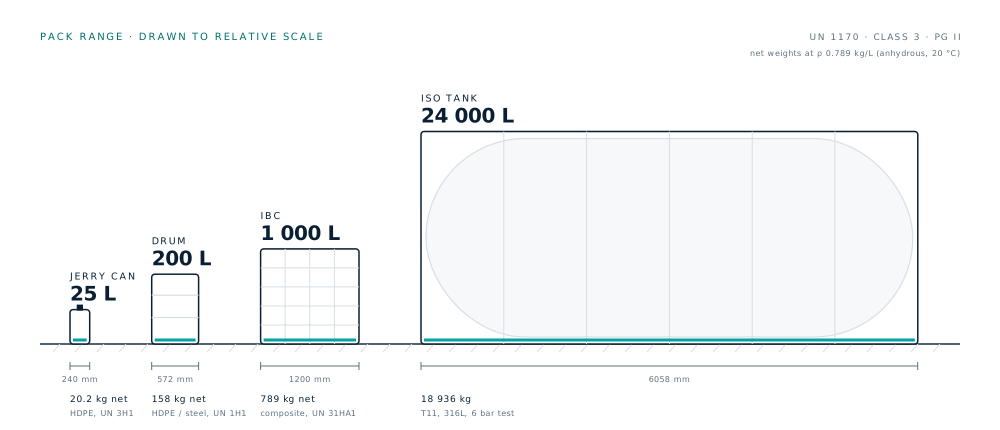
Drums & jerry cans
Approved packs for small and mid volumes. Filled under inert gas, tamper-evident and batch-marked.
Intermediate bulk containers
For customers taking regular mid-scale volumes, with dedicated liners where the grade requires them.
Bulk tank & tanker
Sea and road bulk movements in equipment dedicated to alcohol service, sealed at loading with the seal numbers on the paperwork.
What we do not offer
Flexitanks. They are not permitted for low-flashpoint dangerous goods, whatever a broker may tell you.
Safety
A flammable-liquid site earns its licence every day
Ethanol has a low flash point and a wide flammable range. None of that is solved by a certificate — the certificate is evidence that it is being managed.
Hazardous area classification
The site is zoned and equipment is rated for the zone it sits in, with the classification maintained as a controlled document.
Ignition control
Bonding and earthing on every transfer, controlled fill velocities, and hot work only under permit with gas testing.
Atmosphere control
Inert blanketing on storage and filling, with fixed gas detection interlocked to shutdown.
Emergency response
Systems designed for a polar solvent, trained on-site response, and a plan exercised with the authority rather than filed with it.
Location
Hamriyah Free Zone, Sharjah
A free zone with an established bulk-liquid cluster, road access across the Gulf and marine access for container and bulk movements. Goods in a free zone sit outside the customs territory until they are entered to the mainland, which is the normal structure for a storage and re-export operation.
Road
Direct delivery across the Gulf states, and container haulage to the regional ports.
Sea
Export by container and bulk, with dangerous-goods booking and documentation handled as standard.
Documentation
Certificates of origin and attestation handled through the Chamber of Commerce for export consignments.